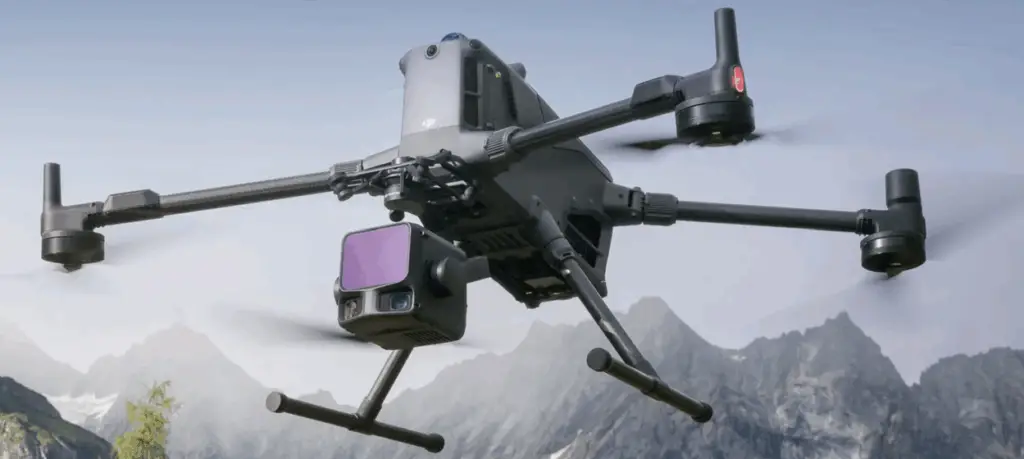
The DJI Zenmuse L3 is DJI’s latest flagship high-accuracy aerial LiDAR payload (launched in November 2025), representing a major advancement over the Zenmuse L2. It’s purpose-built for professional geospatial surveying, topographic mapping, power line/vegetation analysis, forestry, emergency response, infrastructure inspections, and large-scale 3D modeling—perfect for the demanding projects we handle at Collin County Drone Services LLC in the fast-growing North Texas region.We pair it with our DJI Matrice 400 for optimal performance (it’s fully compatible and optimized for the M400’s heavy-lift capabilities, long endurance, and advanced interfaces—note: it’s primarily/exclusively listed for the Matrice 400 in many enterprise configs, with some sources noting backward compatibility to M300/M350 in limited setups, but the M400 unlocks its full potential like extended range and efficiency).Key Capabilities & Features
- Long-Range LiDAR Performance
Features a 1535 nm Class 1 eye-safe laser with a maximum detection range of up to 950 meters (even on low-reflectivity surfaces at 10% reflectivity, tested at 100 kHz pulse rate under bright conditions). This roughly doubles the effective range of the L2 (~450m), enabling safer, higher-altitude flights over vast or obstructed terrain—like rural land development, utility corridors, or forested areas in Collin County. - Superior Penetration & Point Cloud Density
Supports up to 16 returns per pulse (more ground hits through dense vegetation or canopy).
Smaller beam spot size (about 5x finer than L2) for detecting thin features like power lines, branches, or small structures with greater precision.
Enhanced penetration captures more ground points in challenging environments (e.g., dense forests, urban areas), improving terrain model accuracy and completeness for precise surface reconstruction. - Dual High-Resolution RGB Cameras
Two 100-megapixel Micro Four Thirds cameras (one primary for mapping, one for video/secondary tasks) deliver photogrammetry-grade imagery alongside LiDAR data.
This enables simultaneous capture of colorized point clouds, orthomosaics, and high-detail visuals in a single pass—no separate RGB flights needed. - High-Precision Positioning & Accuracy
Integrated high-precision POS system (IMU + GNSS) with post-processed heading accuracy of 0.02° and pitch 0.01° (1σ).
Typical absolute accuracy: 2–4 cm (horizontal/vertical at 300m nadir altitude); real-time Z-axis precision around 15 cm.
Supports RTK/PPK for centimeter-level results when paired with D-RTK 3 Multifunctional Station. - Scanning Modes & Efficiency
Multiple modes: Linear, Star-Shaped (for balanced multi-angle coverage), Non-Repetitive, etc.
Adjustable point rate up to 2 MHz for balancing density and flight time.
When mounted on the Matrice 400: Covers up to 10 km² per flight and 100 km² per day (flat terrain, 300m altitude, 20% side overlap, 17 m/s speed, ~6 hours effective flight time). This slashes mission time for large-area surveys. - Intelligent Workflow Integration
Seamless with DJI Pilot 2 (real-time point cloud preview, density charts, auto-recommended parameters, Power Line Follow up to 130m altitude).
Full end-to-end processing in DJI Terra (point clouds, orthophotos, 3D models from one dataset).
Compatible with FlightHub 2 for team ops and D-RTK 3 for base station accuracy. - Rugged Design
IP54-rated for dust/water resistance.
Operating temp: -20°C to +50°C (-4°F to +122°F).
Weight: ~1.6 kg (plus gimbal connector).
Three-axis stabilized gimbal for smooth data in windy or dynamic conditions.