
Key Benefits of Drone LiDAR for Surveyors
Drone LiDAR Reshapes Land Surveying with Hybrid Precision
The land surveying industry is undergoing a technological shift as drone-mounted LiDAR systems redefine how geospatial data is captured, processed, and delivered. Once considered a niche innovation, drone LiDAR is now emerging as a central component of modern surveying workflows—enhancing, rather than replacing, traditional ground-based methods.
Mounted on unmanned aerial vehicles (UAVs), drone LiDAR (Light Detection and Ranging) systems emit laser pulses to measure distances and generate highly detailed 3D representations of terrain. The technology is particularly effective in environments where conventional approaches struggle, including densely vegetated, hazardous, or hard-to-access areas.
A Clear Advantage in Complex Terrain
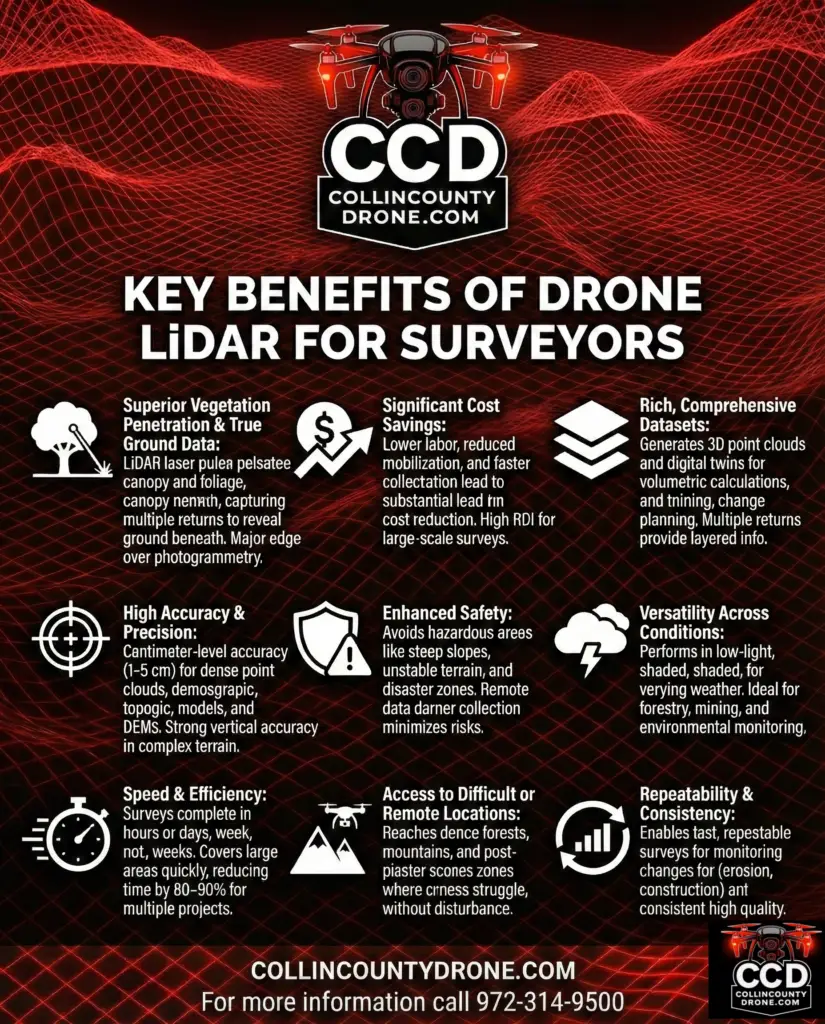
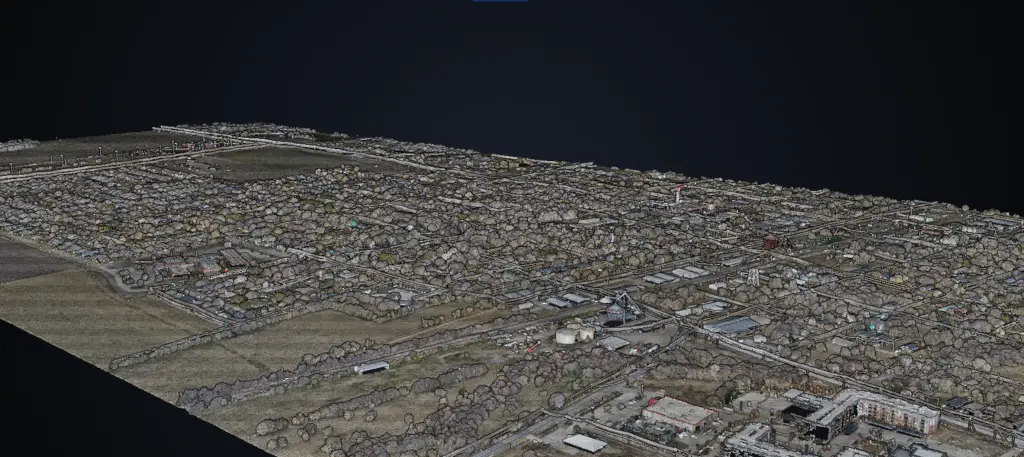
One of drone LiDAR’s most significant strengths is its ability to penetrate vegetation. Unlike photogrammetry, which relies on imagery and captures only the visible surface, LiDAR pulses can pass through canopy gaps and undergrowth, producing multiple returns that reveal the true ground surface beneath. This capability enables surveyors to generate accurate bare-earth models without the need for extensive clearing or manual access.
Modern systems deliver centimeter-level accuracy—typically between 1 and 5 centimeters horizontally and vertically—producing dense point clouds suitable for digital elevation models (DEMs), contour mapping, and detailed topographic analysis. Vertical precision is especially valuable in complex or forested landscapes.
Beyond accuracy, speed is a defining feature. Large areas spanning several square kilometers can be surveyed in a matter of hours rather than weeks. Industry professionals report field time reductions of up to 80–90 percent, allowing crews to manage more projects while lowering operational costs.
Safety and accessibility also play a major role in adoption. Drone LiDAR enables remote data collection over steep slopes, unstable terrain, active construction sites, mining operations, and disaster zones—reducing exposure to risk. Areas once considered logistically or environmentally challenging, such as dense forests and power corridors, can now be mapped efficiently with minimal disturbance.
Integration, Not Replacement
Despite its advantages, experts emphasize that drone LiDAR does not eliminate the need for traditional surveying tools. Instead, it integrates seamlessly into hybrid workflows that combine aerial efficiency with ground-based precision.
Ground Control Points (GCPs), established using GNSS/RTK systems or total stations, remain essential for georeferencing LiDAR datasets. Check points validate alignment and ensure accuracy against established ground truth. The fusion of aerial and terrestrial data is typically handled in platforms such as Global Mapper, ArcGIS, AutoCAD Civil 3D, and LAStools, enabling the creation of comprehensive hybrid deliverables.
In practice, drone LiDAR often handles large, obstructed, or vegetated areas, while ground crews focus on boundary verification, staking, utility mapping, and as-built documentation in accessible zones. This “drone-first, ground-refine” approach allows firms to capture primary data from the air and selectively enhance it with traditional measurements for compliance, densification, or quality assurance.
The result is improved CAD and BIM integration, fewer field errors, optimized labor allocation, and stronger overall project reliability.
Choosing the Right Tool for the Job
For open terrain with minimal vegetation, conventional methods or photogrammetry may remain sufficient and more cost-effective. However, in complex, large-scale, or high-risk environments—such as infrastructure corridors, mining sites, forestry operations, environmental monitoring projects, and urban development—surveyors increasingly view the LiDAR-traditional combination as the industry benchmark.
Many firms now pair LiDAR with photogrammetry in the same project: LiDAR supplies accurate bare-earth data, while imagery provides textured, visually rich overlays for presentation and modeling.
As drone platforms, sensors, and processing software continue to advance, the role of LiDAR in surveying is expected to expand further. Rather than displacing established practices, the technology is elevating them—offering survey professionals new levels of productivity, precision, and versatility.
The future of surveying, industry leaders suggest, lies not in choosing between aerial and ground-based methods, but in combining them strategically to deliver faster, safer, and more accurate results than ever before
A Hybrid Future
As drone platforms, sensors, and processing software continue to advance, the role of LiDAR in surveying is expected to expand further. Rather than displacing established practices, the technology is elevating them—offering survey professionals new levels of productivity, precision, and versatility.
The future of surveying, industry leaders suggest, lies not in choosing between aerial and ground-based methods, but in combining them strategically to deliver faster, safer, and more accurate results than ever before.