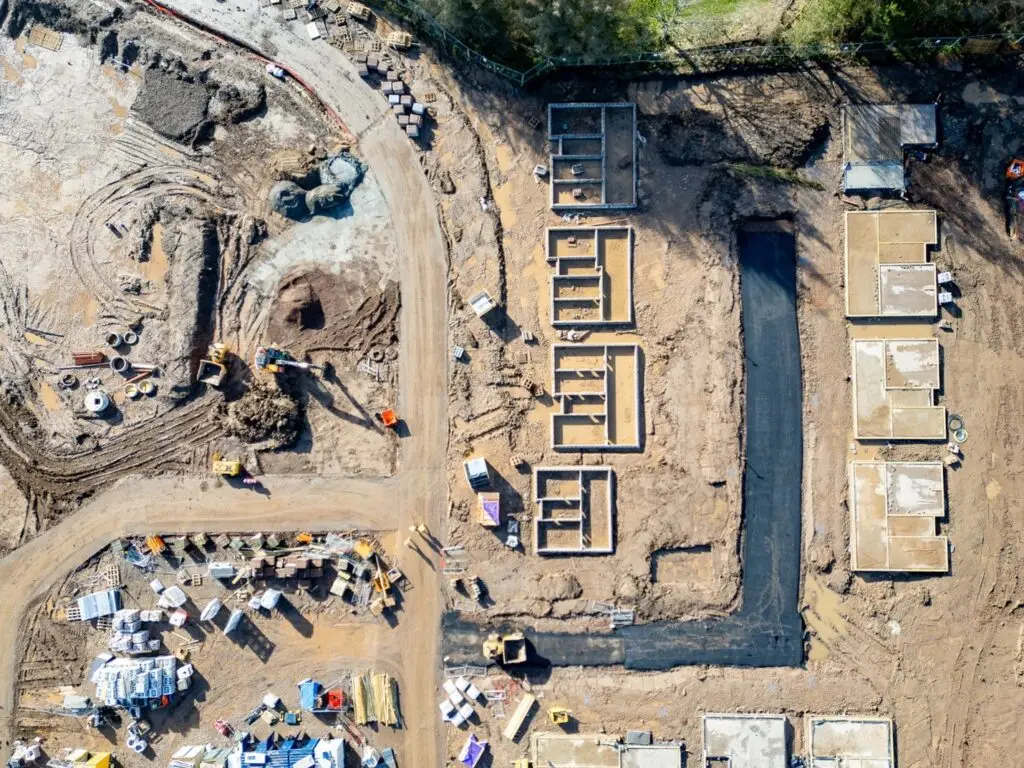
Drone LiDAR vs. 3D Photogrammetry: Choosing the Right Drone Mapping Solution in North Texas
Drone surveying is growing fast across North Texas, and most of our clients end up asking the same question: LiDAR or 3D photogrammetry? If you're planning a construction job in Celina, a land development near Frisco, or an infrastructure survey in the DFW metroplex, picking the wrong one costs you accuracy, money, and time on the schedule.
Both methods can hit survey-grade, centimeter-level accuracy with our RTK/PPK drones. They just solve different problems.
What Is Drone Photogrammetry?
Photogrammetry uses high-resolution drone imagery to build 3D models and maps. The drone flies a pattern and captures hundreds of overlapping photos, and the software stitches them together into terrain and structure using shared reference points.
When Drone Photogrammetry Works Best
Photogrammetry performs well on open, cleared ground, which is the landscape most of our suburban North Texas construction sites sit on. We use it for:
- Construction progress tracking
- Residential and commercial development
- Stockpile and earthwork volume calculations
- Real estate marketing visuals
- Site inspections and documentation
Why North Texas Projects Pick Photogrammetry
For the active construction sites we fly in Celina, Frisco, Prosper, and McKinney, photogrammetry gives you high-resolution visual data at a lower operational cost. If the site is graded and the sightlines are open, photogrammetry is usually the right call.
What Is Drone LiDAR?
LiDAR stands for Light Detection and Ranging. It's an active laser sensor: the drone fires laser pulses at the ground and times the return to build a dense 3D point cloud. Because it generates its own light, LiDAR doesn't depend on sun angle or shadows, and it can shoot lasers through gaps in vegetation to hit the ground underneath.
When Drone LiDAR Is the Right Call
LiDAR is the right tool when the site has cover that imagery can't see through. We use it on:
- Acreage and land development surveys
- Floodplain and drainage analysis
- Forestry and environmental studies
- Utility corridor and power line inspections
- Sites with heavy brush or tree canopy
Why North Texas Projects Pick LiDAR
A lot of the undeveloped parcels our clients bring us have grasslands, tree clusters, or uneven terrain where photos alone won't give you an honest ground elevation. LiDAR sees through the vegetation and gives civil engineers a clean bare-earth model to design from.
Drone LiDAR vs. Photogrammetry: Side-by-Side Comparison
| Feature | Drone LiDAR | 3D Photogrammetry |
|---|---|---|
| Terrain Accuracy | Excellent vertical precision | High in open areas |
| Vegetation | Maps ground beneath trees | Captures surface only |
| Visual Quality | Engineering-focused data | Photorealistic models |
| Lighting Conditions | Day or night operation | Requires daylight |
| Project Cost | Higher equipment investment | More budget-friendly |
| Processing | Faster terrain extraction | Image-heavy processing |
How to Pick the Right Drone Mapping Method for Your North Texas Project
Choose Drone LiDAR If You Need:
- Accurate terrain under vegetation
- Pre-development land surveys
- Utility or corridor mapping
- Engineering-grade elevation models
Choose 3D Photogrammetry If You Need:
- Construction progress reporting
- High-resolution visual models
- Volume measurements and grading verification
- Cost-effective aerial mapping
Why Local Conditions Matter for Drone Surveying in DFW
North Texas isn't one kind of site. On any given week we fly:
- Fast-growing suburban construction
- Mixed rural and urban parcels
- Seasonally changing vegetation
- Large-scale raw land headed for development
That mix is why we usually put photogrammetry on active construction and LiDAR on raw land or environmental work. Matching the sensor to the site cuts rework, speeds up approvals, and keeps the design team from second-guessing the data.
Final Thoughts: Pick the Sensor That Fits the Job
LiDAR and photogrammetry do different work. Our team flies both, and on most projects we can tell you on a quick call which one you need and why.
When the sensor matches the site, drone surveying gets you cleaner data, faster deliverables within 48 hours of the flight, and better decisions through the life of the project. If you're not sure which fits your site, send us the parcel and we'll tell you straight.