Drone Volumetric Surveys for Earthworks Contractors: Cut, Fill, and Stockpile Numbers That Hold Up in Billing
The dirt moves every day. The pay quantities have to match the dirt that moved. If the volumes on your month-end draw are off by even 5 percent on a 100,000 CY pile, you are leaving tens of thousands of dollars on the table or arguing with the owner about quantities a tape measure cannot settle.
We run drone volumetric surveys for earthworks contractors across North Texas. The deliverable is a defensible cut-and-fill report and a set of surface files the owner's engineer can verify independently.
This post covers what we deliver, how accurate the numbers are, and how we fit into a contractor's workflow on an active job.
What we deliver on a volumetric flight
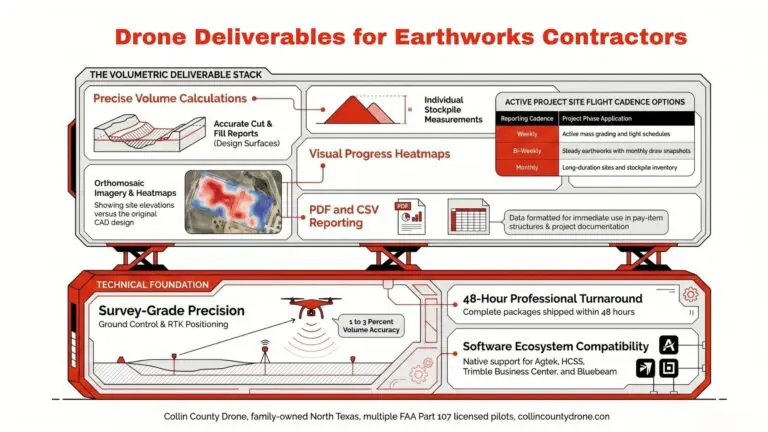
Every volumetric survey ships as a package with the numbers, the supporting data, and the files you need to defend the quantities.
- Cut and fill volumes calculated against your design surface (imported from CAD, Civil 3D, Agtek, or a prior survey)
- Stockpile volumes with a PDF report per pile and a CSV summary for the full yard
- Cut and fill heatmap showing where the site is high or low versus plan
- Georeferenced orthomosaic (1 to 2 cm GSD) for visual context and field measurement
- Dense point cloud (LAS 1.4) of the current surface
- Digital Terrain Model (GeoTIFF) ready for your engineer to compare against the design
- Progress comparison against the previous flight when the site is on a recurring cadence
- Flight report with weather conditions, RTK solution quality, and check point RMSEz
Volumes are reported against the reference surface the project calls for: a design grade from a CAD file, a base plane at a stockpile pad elevation, or the previous survey's as-flown surface. You tell us the baseline. We deliver volumes and the audit trail.
How accurate are the numbers
Industry benchmarks on well-flown drone photogrammetry and LiDAR volumetrics run in the 2 to 3 percent range against ground-truth measurements. Propeller Aero, a leading platform in this space, publishes 3 cm accuracy on drone volume calculations with proper RTK and ground control. Our internal QA target on volumetric work is RMSEz of 3 to 5 cm on hard-surface check points, which translates to volume accuracy of 1 to 3 percent on stockpiles larger than a few hundred cubic yards.
The math pays for the rigor. A 5 percent error on a 100,000 CY stockpile is 5,000 CY. At $4 to $8 per yard, that is real money every single draw. Running the survey right is cheaper than arguing over the numbers.
What drives accuracy on volumetric work
- RTK or PPK positioning during the flight, verified against a ground check point
- Ground control distributed around the site, not bunched in one area
- Sufficient image overlap: 80 percent frontal and sidelap on photogrammetry, multiple passes and cross-track flights on LiDAR
- A clean pad survey for stockpiles, or a trusted design surface for earthworks progress
- Flying in conditions that let the sensor perform: low wind, consistent light, dry ground
We run every flight with those controls in place. If conditions will not support the accuracy spec, we do not fly. We rebook.
Recurring flights on an active site
Most of our earthworks work runs on a subscription cadence. The right interval depends on how fast dirt is moving and how the client wants to report progress.
- Weekly: active mass grading, tight schedule, frequent owner reporting
- Bi-weekly: steady earthworks phase, monthly draws backed by mid-month progress snapshots
- Monthly: long-duration sites, stockpile inventory, month-end pay quantities
- On-demand: pre-bid topo, pre-construction baseline, as-built at turnover
Recurring cadence lets us lock in ground control, keep the same flight plan, and deliver progress comparisons that are consistent flight to flight. That consistency matters when volumes are being used to pay or be paid.
File formats contractors use
The deliverable drops directly into the tools earthworks contractors run in the field and in the office:
- Agtek Earthwork 4D and SmartDirt: TIN surface export, point cloud support
- Trimble Business Center: native LAS and surface import, built-in volume tools
- HCSS HeavyJob and HeavyBid: PDF and CSV reports line up with pay item structures
- Bluebeam Revu: markup-ready PDFs of heatmaps and orthomosaics
- Civil 3D: point clouds, surfaces, and contours for your engineer or surveyor to verify
- DJI Terra, Propeller, DroneDeploy: point cloud and orthomosaic formats import cleanly
If your estimator or PM needs a custom export, ask. We write LandXML, DWG with TIN surfaces, shapefile pile boundaries, or CSV point tables on request.
The pay-quantity question
Most drone volumetric disputes come down to two questions. What surface did you compare against? And who signed off on the baseline?
We answer both in the deliverable report. Every volume calculation cites the reference surface by name, date, and source (CAD design, previous flight, pad survey). Every report notes the accuracy check against independent ground points and the resulting confidence interval on the volume. Your engineer, or the owner's engineer, can rerun the calculation against the same surface and get the same answer.
If a dispute lands on a pay estimate, we have done the work that lets you stand behind the number.
Safety, site access, and coordination
An active dirt site is busy. We coordinate every flight with your site super so we are not flying when a spotter is mid-lift or a scraper is mid-cycle. Most sites we can fly over lunch or at shift change in 30 to 60 minutes of air time for a typical 20-to-50-acre phase.
Our pilots are FAA Part 107 certified and carry $1 million aviation liability coverage. We show up on site with the documentation your safety officer will want before we launch.
Common questions from earthworks contractors
Do you compare the drone survey against our design surface?
Yes. Send the design surface as a TIN or LandXML from Civil 3D, Agtek, or your engineer. We calculate cut and fill volumes against that design and deliver a report with volumes, a heatmap showing high and low zones, and the raw surface for your estimator or engineer to reproduce the calculation.
Can you fly while equipment is operating on the site?
Yes with coordination. We brief the site super before every flight and run a pilot-in-command plus visual observer team on active sites. On most jobs we schedule flights over lunch or at shift change when the site is quiet, giving us 30 to 60 minutes of clean air time for a 20 to 50 acre phase without stopping production.
How accurate are drone volumes for pay quantities?
On well-flown RTK photogrammetry or LiDAR with proper ground control, volume accuracy runs 1 to 3 percent on stockpiles larger than a few hundred cubic yards. Every report includes the vertical accuracy check against independent ground points and the resulting confidence interval on the volume. That is the number your owner's engineer can verify.
Can you baseline a pad or site before mobilization?
Yes. A pre-mobilization topo gives you the original ground surface for every cut and fill calculation that follows. We fly the site, deliver the baseline DTM, and every subsequent progress flight compares against that known starting surface. Baseline flights pay back on every progress cycle for the rest of the project.
Which cadence works best for active mass grading?
Weekly on active mass grading with heavy production and owner reporting. Bi-weekly on steady earthworks with monthly draws. Monthly on long-duration sites where the pace is slower. We lock in the cadence at project start and hold the same flight day and pilot for the life of the job.
Who signs off on the baseline reference surface?
You do, in writing, before the first progress flight. Every volume report cites the baseline by file name, source, and date. If the baseline needs to change (design revision, scope change, new pad elevation), we document the change and re-set the calculation against the new reference. That keeps the audit trail clean if a pay estimate is ever disputed.
Work with us
Collin County Drone is a family and veteran-owned commercial drone services company based in Celina, Texas, serving earthworks contractors across Collin County and North Texas. Our team flies LiDAR and photogrammetry missions with RTK and PPK positioning, processes deliverables in 48 hours, and ships reports in the formats your estimators and engineers already use. If you have an active site and want to talk through cadence, baseline surface, or pay-quantity reporting, get in touch.