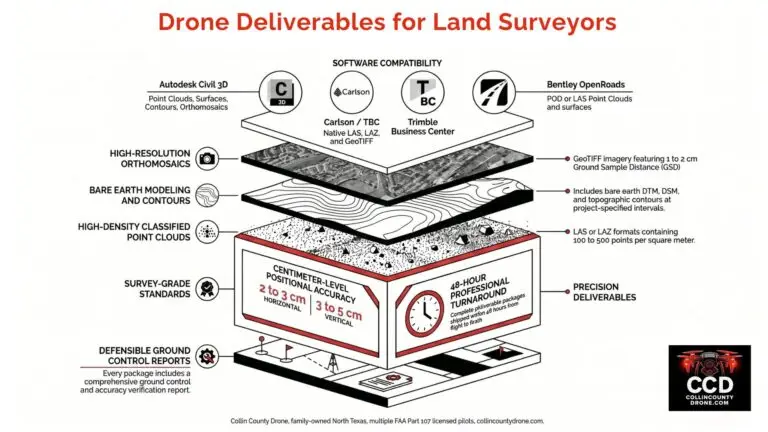
Drone LiDAR and Photogrammetry for Land Surveyors: Survey-Grade Deliverables in 48 Hours
If you are a licensed land surveyor in North Texas, the question is not whether drone data belongs in your workflow. It is whether you build the capability in-house or bring in a reliable outside crew on the days when a drone is the right tool for the site.
We built Collin County Drone for the second group. We are a veteran and family-owned commercial drone services company based in Celina, Texas. Our pilots are FAA Part 107 certified and trained across LiDAR, photogrammetry, thermal, and multispectral missions. We ship deliverables back to you ready to drop into Civil 3D, Carlson, or Trimble Business Center.
This post covers what we deliver for surveyors, how we hit the accuracy spec, and the standards we work to so the deliverable you sign and seal is defensible.
What "survey-grade" means on a drone deliverable
"Survey grade" gets thrown around in drone marketing. It should mean one thing: the final point cloud or orthomosaic has been verified against independent check points, and the reported accuracy meets a stated class in the ASPRS Positional Accuracy Standards for Digital Geospatial Data (Edition 2, 2023).
On most topographic work, a properly run drone LiDAR dataset hits 3 to 5 cm RMSEz on non-vegetated surfaces with RTK/PPK direct georeferencing and a small GCP network for QA. Photogrammetry with RTK-enabled imagery and a well-distributed GCP set hits 5 to 10 cm vertical in open terrain. Those numbers are verified at independent check points, not at the GCPs used in the solution.
If the project calls for tighter accuracy, we plan for it: lower altitude, more overlap, denser ground control, more check points. If the project does not need tight accuracy, we do not over-engineer the flight. That is how we keep the pricing honest.
Deliverables we produce for licensed surveyors
Every deliverable package includes the data plus the documentation you need to sign and seal the work.
Standard LiDAR deliverables
- Classified LAS 1.4 or LAZ point cloud at 100 to 500 points per square meter
- Ground classification separated from vegetation, structures, and buildings
- Bare-earth Digital Terrain Model (DTM) as GeoTIFF float32 raster
- Digital Surface Model (DSM) as GeoTIFF
- Topographic contours at the interval the project calls for
- Boresight calibration report and trajectory solution quality report
- Independent check point RMSEz table
- ASPRS accuracy class statement
Standard photogrammetry deliverables
- High-resolution orthomosaic (GeoTIFF, RGB 8-bit) at 1 to 2 cm ground sample distance
- Dense photogrammetric point cloud (LAS 1.4)
- 3D textured mesh (OBJ, FBX, or Cesium 3D Tiles) when the project calls for one
- GCP report with distribution map and residuals per point
- Check point accuracy statement
Both packages deliver in the coordinate system and datum you specify. Default for North Texas work is Texas State Plane North Central (NAD83, US Survey Feet) with NAVD88 orthometric heights. We deliver in any published CRS or a project-specific local grid on request.
Ground control, RTK, and PPK
We run every flight on RTK or PPK and back that up with surveyed ground control placed around the project extent.
For RTK, we connect to the Texas CORS network through cellular or set up a local base on a published control point. For jobs where cellular coverage is shaky, we log PPK data on both the aircraft and a base receiver and process the trajectory in Inertial Explorer or POSPac after the flight.
Ground control targets go out before the first flight of the day: planar high-reflectivity panels for LiDAR, checkerboard survey targets for photogrammetry. We envelope the survey area with 6 to 8 well-distributed GCPs on most jobs, more on larger or complex sites. Independent check points go in as a separate set. They are used for accuracy verification only and never enter the georeferencing solution.
If you have an existing control network or published benchmarks on the site, we tie into it. If you want your own surveyor on site to run GCPs, we coordinate. If the project requires our crew to run GCPs with a GNSS rover or total station, we handle that in-house.
File formats and software compatibility
Standard deliverables drop directly into the tools surveyors use every day:
- Autodesk Civil 3D: point clouds, surfaces, contours, and orthomosaics import cleanly
- Carlson Survey: LAS/LAZ and GeoTIFF, surface import
- Trimble Business Center: native LAS and GeoTIFF, trajectory files in IE or POSPac formats
- Bentley OpenRoads and MicroStation: POD or LAS point clouds, GeoTIFF surfaces
- TopoDOT: classified LAS support, feature extraction workflows
- Esri ArcGIS Pro: all standard raster and point cloud formats
- LP360 and TerraScan: professional point cloud classification and analysis
- CloudCompare: open-source QA, same LAS workflow
If you need a custom export, ask. We write deliverables into LandXML, DWG with TIN surfaces, shapefiles of extracted features, or whatever a downstream tool wants.
ASPRS 2023 standards and QA
The ASPRS Positional Accuracy Standards for Digital Geospatial Data, Edition 2, were published in 2023 and clarified in 2024. The headline changes that affect survey deliverables: the 95% confidence level was dropped as a reported accuracy measure (RMSE is the reported metric), Vegetated Vertical Accuracy is reported separately and no longer fails a project on its own, and the minimum check point count for full accuracy assessment increased from 20 to 30 on projects that require it.
We write every LiDAR and photogrammetry deliverable against these standards. The accuracy statement names the class, the number of check points used, and the RMSEz in both non-vegetated and vegetated areas.
For a smaller job where a 30-point check network is overkill, we deliver a documented accuracy assessment using the check points that fit the project scale and note the scope in the report. That gives you defensible numbers without billing you for work the project does not need.
When to call us and when to keep it in-house
Call us when:
- You need centimeter-grade topo over 5 to 500+ acres
- You want to extend what your field crew can deliver in a day
- Vegetation or water is in the way of a clean ground survey
- The site is unsafe or slow to walk on foot
- The client needs 48-hour turnaround from flight to deliverable
Keep it in-house when:
- The project is smaller than a quarter acre
- The accuracy target is tighter than 2 cm vertical and the site is open enough for conventional methods
- The project is a boundary retracement or monument recovery that does not benefit from aerial data
We are not trying to replace your field crew. We run the flight and the processing. You run the survey. Your stamp goes on the deliverable.
Common questions from surveyors
Do you deliver data ready for a licensed surveyor to sign and seal?
Yes. Every deliverable ships with the metadata a PLS needs: coordinate system and datum in the header, ASPRS accuracy class statement, GCP and independent check point report with RMSEz, trajectory solution quality log, and boresight calibration record. Your stamp goes on the deliverable. We run the aerial data collection and processing under your survey.
What ASPRS accuracy class do you routinely hit on LiDAR?
On open terrain with RTK/PPK and proper ground control, we hit QL1 (10 cm RMSEz, minimum 8 pts/m²) comfortably. On most survey work we hit QL0 (5 cm RMSEz, 20+ pts/m²) and document it against independent check points. Tighter classes are achievable on smaller areas with denser ground control and lower flight altitude.
How do you handle dense vegetation or canopy cover?
Standard protocol: increase point density to multiply the chances of pulses finding canopy gaps, add cross-track flight lines to capture returns from multiple angles, and schedule deciduous sites for leaf-off conditions when the project allows. We classify ground returns in TerraScan or LP360 and report ground point density in the deliverable. Where canopy stays dense and ground penetration is poor, we recommend ground-truth profile lines to validate the DTM.
Can you tie into our existing control network?
Yes. Send us the coordinate system, datum, and published control points on the site. We occupy or tie into your control, run GCPs against it with a GNSS rover in RTK or static mode, and document every measurement in the GCP report that ships with the deliverable.
What happens if cellular coverage drops and RTK is lost mid-flight?
We log PPK data on the aircraft and the base receiver on every flight, so RTK loss is not a data loss. We process the trajectory post-flight in Inertial Explorer or POSPac and deliver the same survey-grade accuracy. Every flight report notes the RTK fix percentage and whether PPK post-processing was used.
Can you provide the raw data for in-house reprocessing?
Yes on request. We hand over the raw LiDAR scanner files, IMU and GNSS logs, camera image sets, and base station RINEX files. Many firms want to run their own trajectory solution or point cloud classification. We support that and will scope raw data delivery in the proposal.
Work with us
Collin County Drone is a family and veteran-owned commercial drone services company based in Celina, Texas, serving Collin County and the broader North Texas market. Our team of FAA Part 107 licensed pilots runs LiDAR, photogrammetry, and thermal missions to survey-grade standards. Deliverables ship 48 hours after the flight. If you have a project and want to talk through accuracy, GCP strategy, or deliverable format, get in touch.